
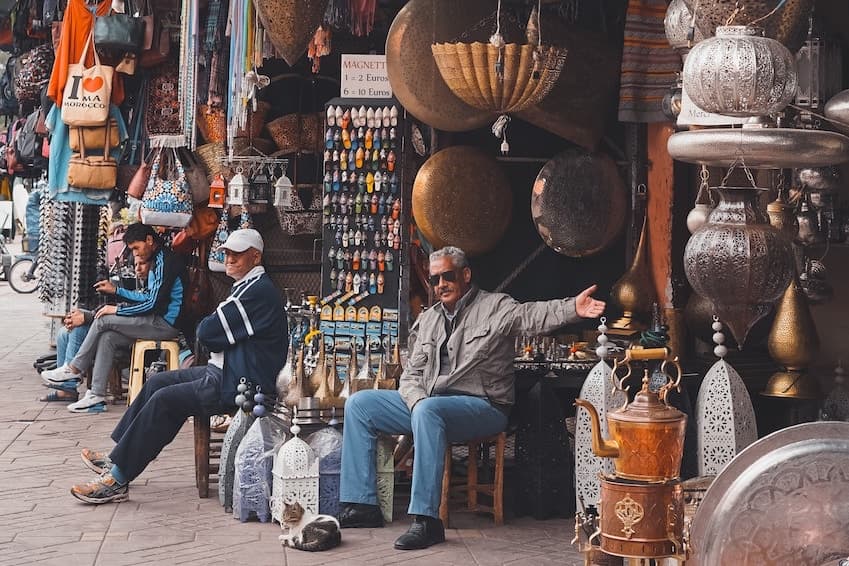
How to Bargain in Morocco: A Guide to Negotiating Prices
Learn how bargaining works in Morocco, what prices you can negotiate, how much to offer and when it is better to walk away.
Bargaining is a normal part of shopping in Moroccan souks and markets, but that doesn't mean every single purchase has to turn into a negotiation. For first-timers, the hard part isn't the haggling itself — it's knowing when bargaining is even expected, roughly what to offer, and when a price is already fine as is.
You're not trying to squeeze out the lowest number possible. A good negotiation is one where you know what you're buying, have a rough sense of what similar things cost, and land on an amount that feels fair on both sides.
Once a few habits click, bargaining stops feeling intimidating. Ask questions, make an offer, compare a few shops, walk away if something's off — none of it has to turn into an argument.
First, figure out if you should be bargaining at all
Not everything in Morocco is negotiable. Supermarkets, modern stores, pharmacies, most restaurants, anywhere with prices clearly marked — you pay what's on the tag.
Bargaining lives mainly in the traditional souks and markets: souvenirs, clothing, leather goods, rugs, handicrafts, some services. Even there, most sellers have a real price in mind rather than expecting an endless back-and-forth.
If you're not sure, just ask if the price is fixed. Takes two seconds and clears up how the whole exchange is going to go.
Start here
Before you negotiate anything, check whether the price is actually negotiable in the first place. A fixed price isn't something you talk down.
Do a little homework before you're in the souk
Negotiating gets a lot easier once you have some idea of what something should cost. With zero reference point, you can't really tell if an offer's reasonable or if you're just reacting to a number that sounds big.
You don't need to memorize a price list. A quick look at typical prices before your trip, or comparing a few shops once you're there, gives you enough to work with.
This matters most for the bigger purchases — rugs, leather bags, carpets, handicrafts — where quality swings the price a lot more than with something small.
Ask the price first
Ask how much before you say anything about what you'd pay. Hear the number, take a second look at the item, then decide what you think it's actually worth.
If it's more than you want to spend, counter with something lower — but keep it realistic. Lowballing hard just because you assume the seller expects it doesn't get you anywhere useful.
A relaxed, friendly tone gets you further than treating the whole thing like a standoff.
Make a reasonable opening offer
There's no magic percentage to knock off every souk price — it depends on the product, its quality, the seller, and where they started.
Figure out beforehand what you'd genuinely be happy paying, then open a bit below that so there's room to move toward the middle.
If the seller accepts your first offer right away, that doesn't mean you got played. It probably just means you offered fairly. Bargaining isn't a contest to win — it's about landing on a number you're comfortable with.
- Know roughly what similar items cost
- Decide your comfortable max before you start
- Open with a number you'd actually be fine paying
- Leave room for the conversation to move
You don't have to bargain every single time
It's tempting to haggle over everything just because that's how souks work. But if a price already feels fair to you, there's nothing wrong with just paying it.
A few dirhams might be nothing to your travel budget while actually mattering to a small seller. Bargaining works best as finding a price that works for both of you — not squeezing every purchase as low as it'll go.
Use comparison shopping as your reference point
No idea if something's overpriced? Walk a bit and check similar items in a few other shops. You don't need to announce that you're comparing.
Two or three comparisons usually tell you fast whether the first price was off, or if you're just seeing normal shop-to-shop variation.
Just remember: items that look alike aren't always the same quality. Check the material, the construction, the size before you compare prices head to head.
Simple approach
Compare a few similar products first, then negotiate once you actually know what a normal price looks like.
Know when to walk
Walking away ends a stalled negotiation faster than anything else. If the seller won't get to a number you like, thank them and move on.
Sometimes they'll call out a lower price as you're leaving. Works for you? Go back and finish it. Doesn't? Just keep walking.
This isn't a trick or a pressure tactic — it's just an honest way of saying you're not going higher than your limit.
Don't feel bad about saying no
A seller might spend real time showing you things, explaining the craftsmanship, making the case for why something's special. It's normal to feel a bit awkward walking away after that.
But browsing doesn't obligate you to buy. Thank them for their time and go if the product or the price isn't right.
Polite and firm aren't opposites. "Thank you, but no" usually does the job on its own.
Watch out when things get confusing
Most negotiations are simple, but things can blur when several items are being discussed at once or numbers are flying fast. Before you agree to anything, make sure you know exactly what you're buying and what the price covers.
Buying more than one item? Confirm whether the quote is per item or for everything. For anything pricier, repeat the final number back to make sure you both mean the same thing.
A few extra seconds of clarifying beats sorting out a misunderstanding after you've already paid.
- Confirm the final price before paying
- Clarify per-item vs. total for the group
- Know exactly what's included
- Slow down if the conversation gets muddled
What about taxis and other services?
Negotiating isn't just a shopping thing. Longer journeys, private transfers, guides, and activities often run on agreed prices rather than a fixed tariff.
Same principle applies — ask the cost upfront and confirm what's included. Any extra charges need to come up before the service starts, not after.
Where taxi meters apply, use them; that solves the pricing question on its own. For flat-rate services, just lock in the number beforehand.
Don't negotiate through discomfort
If someone's pushing hard, following you around, or ignoring a clear no, you don't owe them a continued negotiation. Getting out of the situation matters more than getting a good price.
Leave, head toward a busier spot, or just pick a different shop. There's almost always another option nearby, especially in busy tourist areas.
The best deal is one you're actually comfortable with
There's no formula that works everywhere in Morocco — prices, quality, and seller expectations all shift from city to city and shop to shop.
Skip trying to memorize a magic percentage. Focus instead on understanding what you're actually buying: compare prices, ask questions, know your limit before you commit.
Once bargaining stops feeling like a competition, it gets a lot easier. It's just a conversation about a price, and whether the final number works for you.
Travel tip
Negotiating confidently just means knowing your reference price before you start. You don't need the lowest price out there — just enough to recognize a fair one.
Negotiate with confidence, not pressure
Bargaining can feel intimidating at first, but it stops being a big deal once you realize you don't have to negotiate every purchase. Know where it's expected, compare a few prices, and decide what you're comfortable paying.
Stay friendly, take your time, and remember you can always walk away. A fair purchase isn't necessarily the cheapest one — it's one where you know what you're paying for and feel good about it afterward.
Found this useful?
Share it with someone planning a trip to Morocco.